ABE Series – anti-blocking hard-coated PET films for ITO.
The ABE series is a hard-coated PET film line optimised for ITO processes. With anti-blocking structures and multiple coating combinations, ABE films support stable handling, lamination and patterning in transparent conductive applications.
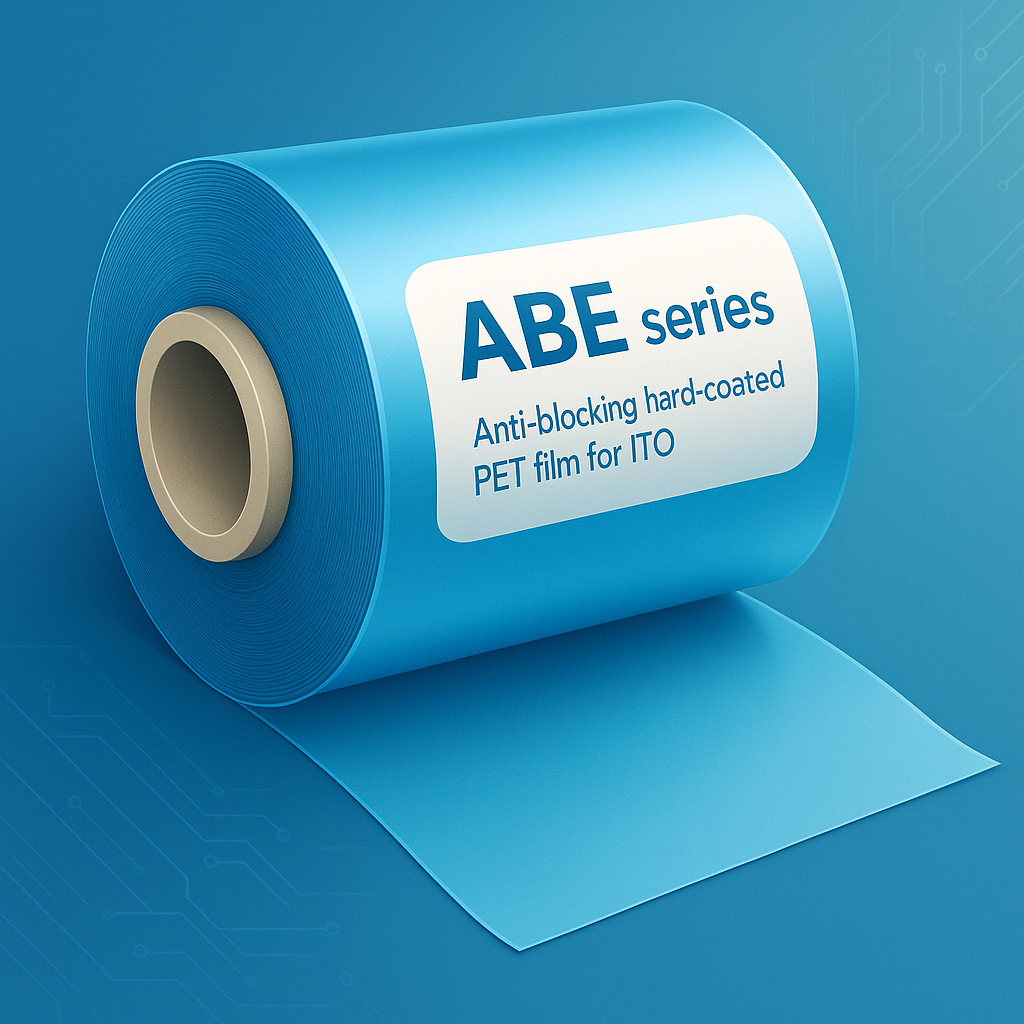
Hard-coated PET films with anti-blocking characteristics for ITO coating and transparent electrode processes, balancing optical quality and processability.
Where ABE films are typically used.
ITO-coated PET substrates
Used as base films for transparent conductive ITO layers in touch panels, sensors and EMI-shielding films, where blocking and sticking must be avoided.
Roll-to-roll coating & printing
Anti-blocking design supports roll-to-roll sputtering, coating and printing by keeping layers separable and stable during winding.
Laminated display electrodes
Suitable as a functional layer in laminated electrode stacks for displays and optical devices requiring clean surfaces and consistent handling.
ABE series line-up & functions.
* Exact optical / mechanical values should be confirmed from the official datasheet for each model.
A general-purpose ABE grade designed as a base film for ITO coating lines. It provides stable anti-blocking performance and good optical clarity.
- Hard-coated PET with controlled anti-blocking surface.
- Balanced scratch resistance and transparency.
- Recommended as the standard ABE grade for many ITO processes.
An ABE grade tuned for more demanding coating / sputtering lines, where blocking, scratching or sticking between layers must be further reduced.
- Improved anti-blocking profile vs. ABE2000.
- Supports stable winding and unwinding in high-speed R2R equipment.
- Helps maintain surface quality through multiple process steps.
ABE3200 adds a more functional surface design for lamination, printing or further coating, while keeping the anti-blocking characteristics of the series.
- Surface engineered for good adhesion / lamination workability.
- Maintains low blocking between rolled layers.
- Used where the ABE film becomes part of a multi-layer stack.